ESIL Collaborative Book Prize
2027 ESIL Collaborative Book Prize Submission
The ESIL Collaborative Book Prize was created in 2022, as a counterpart to the ESIL Monograph Prize.
Practical information on the ESIL Collaborative Book Prize and on how to submit your nomination is available below:
-
Publishers are responsible for covering all shipping costs for the nominated books sent to the ESIL Secretariat, including, where applicable, VAT, customs duties, and postal handling fees.
-
Deadline for the receipt of ESIL Collaborative books is 15 February 2027. Books received after the deadline, or whose delivery is subject to the payment of additional fees, unfortunately cannot be considered eligible for an award.
-
The European University Institute is closed between 14 December 2026 and 7 January 2027 so please avoid sending books during this period.
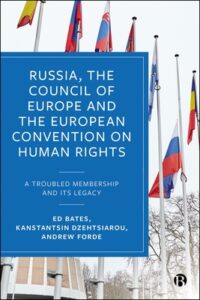
2026 ESIL Collaborative Book Prize Winner
The 2026 ESIL Collaborative Book Prize was awarded in September 2026 during the 21st ESIL Annual Conference in Málaga to Ed Bates, Kanstantsin Dzehtsiarou and Andrew Forde for their work Russia, the Council of Europe and the European Convention on Human Rights (Bristol University Press, 2025)
Jury’s report
While there were many excellent collaborative books among the nominees, the jury finds the co-authored work by Bates, Dzehtsiarou, and Forde, to be an extremely worthy winner for the following reasons:
- Originality:
- Substance: While it is not surprising that the dramatic events surrounding Russia’s expulsion from the Council of Europe in March 2022 have given rise to academic publications, the authors’ approach in this book is original in that it provides a comprehensive analysis not only of Russia’s membership record, but also of its impacts on Europe’s system for human rights protection. The historico-legal perspective consistently followed by the authors is also an exceptional asset of this book.
- Format: Co-authored monographs are relatively rare compared to edited volumes. To succeed, a co-authored monograph requires extensive and time-consuming collaboration and consultation. It seems obvious that the three authors of this book have really engaged with each other and each other’s knowledge of their shared topic. The reader clearly benefits from their teamwork as the outcome is a truly collaborative and homogenous volume.
- Quality: The book is a pleasure to read. It is very well-written and conveys the authors’ extensive knowledge of a complex topic in a manner that makes it easily accessible – also beyond the academic community.
- Timing and timeliness: As stated in the acknowledgements, the monograph originates from the authors’ exchanges on social media in March 2022. It is impressive that the authors have been able to prepare a manuscript of this quality and pressing importance for publication in three years.
- Relevance: The book is not only relevant for those who are interested in Russia and the Council of Europe. Providing an in-depth analysis of the relationship between a key international organization and a difficult member state, this book is arguably a must-read for anyone with an interest in safeguarding the integrity of international institutions.
Previous Collaborative Book Prize Winners
- ESIL Collaborative Book Prize 2025: Jolene Lin and Jacqueline Peel for Litigating Climate Change in the Global South (OUP, 2024)
- ESIL Collaborative Book Prize 2024: Immi Tallgren for Portraits of Women in International Law (OUP, 2023)
- ESIL Collaborative Book Prize 2023: Anne Peters, Jérôme de Hemptinne, and Robert Kolb for Animals in the International Law of Armed Conflict (CUP, 2022)
- ESIL Collaborative Book Prize 2022: Helmut Philip Aust (Freie Universität Berlin) and Janne E. Nijman (University of Amsterdam) for International Law and Cities (Edward Elgar Publishing, 2021).